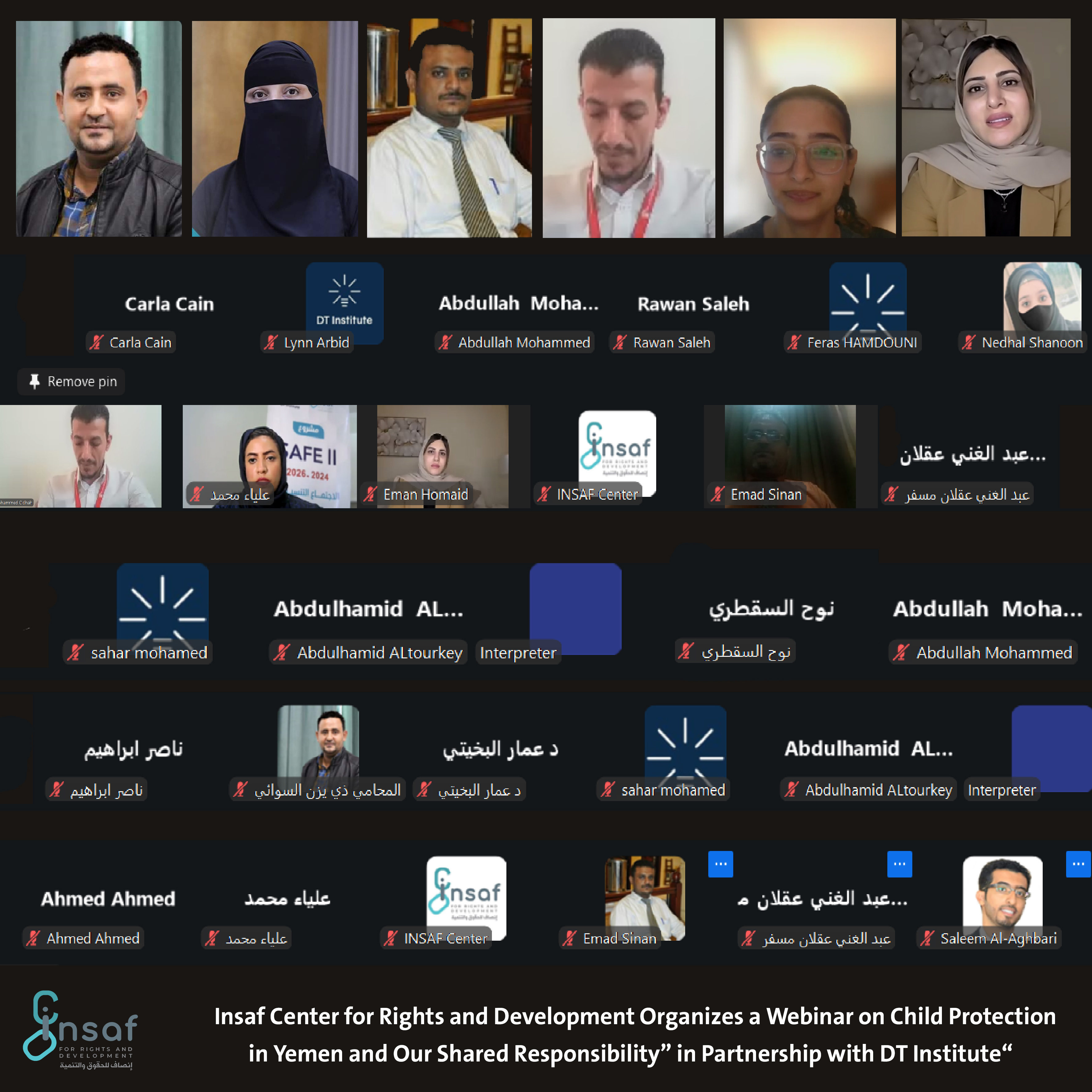

The Insaf Center for Rights and Development organized today a virtual webinar via Zoom titled “Child Protection in Yemen and Our Shared Responsibility,” in partnership with DT Institute and with the participation of a group of experts and key actors in the fields of child protection and social development.
During the webinar, held on 1 December 2025 from 4:00–6:00 p.m. Yemen time, speakers discussed the most pressing challenges facing children in Yemen, particularly in the context of displacement, marginalization, and various forms of violations. The discussion also highlighted governmental, institutional, community, and legal efforts aimed at protecting children and promoting their rights.
The session was moderated by Alya Mohammed, with contributions from:
Eman Homaid – Chairperson, Insaf Center for Rights and Development
Mohamed Odhah – Co-National Coordinator, Child Protection Sub-Cluster
Lynn Arbid – Program Officer, DT Institute
Emad Sinan – Director of Complaints and Reports, Ministry of Human Rights
Um Al-Khair Abdullah – Director of Social Defense Department, Office of Social Affairs and Labor – Aden
Thiyazan Al-Sawaee – Lawyer and Member of the Community Reconciliation Committee, SPARK Project
Throughout the discussions, the webinar explored several key themes, including:
Emerging on-the-ground risks in Yemen and their impact on child protection
The six grave violations against children in conflict contexts
The role and responsibilities of relevant government authorities in child protection
Challenges faced by civil society organizations in providing protection services and response mechanisms
Review of child-related legislation and policies and their alignment with the current reality
Participants also examined the causes behind the worsening violations and their social, psychological, and educational consequences. They presented practical insights to strengthen protection mechanisms at both institutional and community levels.
The webinar emphasized the importance of adopting several key recommendations, including:
Strengthening community awareness and education on children’s rights and the risks of violence and violations
Building the capacity of government entities working in child protection and enabling them to perform their roles effectively
Enhancing coordination between the government, local organizations, and international actors to ensure a unified and effective response
Reinforcing the idea that child protection is a shared responsibility involving government institutions, organizations, civil society, and families
At the conclusion of the event, participants underscored the need to continue joint efforts to find sustainable solutions that contribute to building a safe environment for children in Yemen and ensure their rights to dignity, education, protection, and healthy development.