

Yemeni Judges and Legal Experts Draw a Roadmap to Combat Cybercrimes, Especially Online Blackmail
At the conclusion of the specialized training workshop on “Strengthening the Legal Framework and Judicial Response to Cybercrimes,” organized by #Insaf Center for Rights and Development as part of the project “Electronic Justice for Women in #Yemen (Brave Women),” held from May 5–7, 2026, at Lotus Hotel in Aden, in which I had the honor of participating as a trainer, I believe that our responsibility does not end with conducting workshops in this sensitive field. It must also extend to community advocacy and legal awareness to confront cybercrimes, foremost among them online blackmail.
From this standpoint, I present to the community a set of messages and recommendations to raise awareness about the dangers of these crimes and to protect our sons and daughters from falling into the traps of hackers and individuals who violate the privacy of others by using threats of exposure or defamation to achieve financial, moral, or sexual gains.
Accordingly, we emphasize the following:
First: The in-depth discussions and legal analyses during the workshop showed that traditional legal texts are no longer sufficient to address crimes committed through digital platforms. This requires the urgent adoption of a modern cybercrime law that keeps pace with technological developments and aligns with the Arab Convention on Combating Information Technology Offences.
Second: The Yemeni government must fulfill its national and international obligations by issuing comprehensive legislation that addresses emerging forms of cybercrime, including deepfake crimes linked to artificial intelligence technologies.
Third: There is a need to establish specialized judicial divisions and train digital law enforcement officers with the technical skills necessary to track offenders and fake accounts. In addition, a Computer and Network Emergency Response Center should be established within the Ministry of Telecommunications to provide technical support to judicial and security authorities.
Fourth: It is important to establish direct communication channels with major technology companies such as Meta, X, and Telegram in order to accelerate the process of tracking offenders and removing blackmail-related content, especially in cases involving deepfakes and artificial intelligence.
Fifth: Safe and confidential reporting mechanisms for online blackmail crimes must be provided, while ensuring that victims are not legally prosecuted due to any prior communication exploited by the offender. The victim’s privacy must remain a red line that cannot be violated throughout all stages of investigation and trial.
Sixth: A legal and psychological support unit should be established for survivors of online blackmail, accompanying victims from the moment of reporting until compensation and recovery, helping to break the barriers of fear and social stigma.
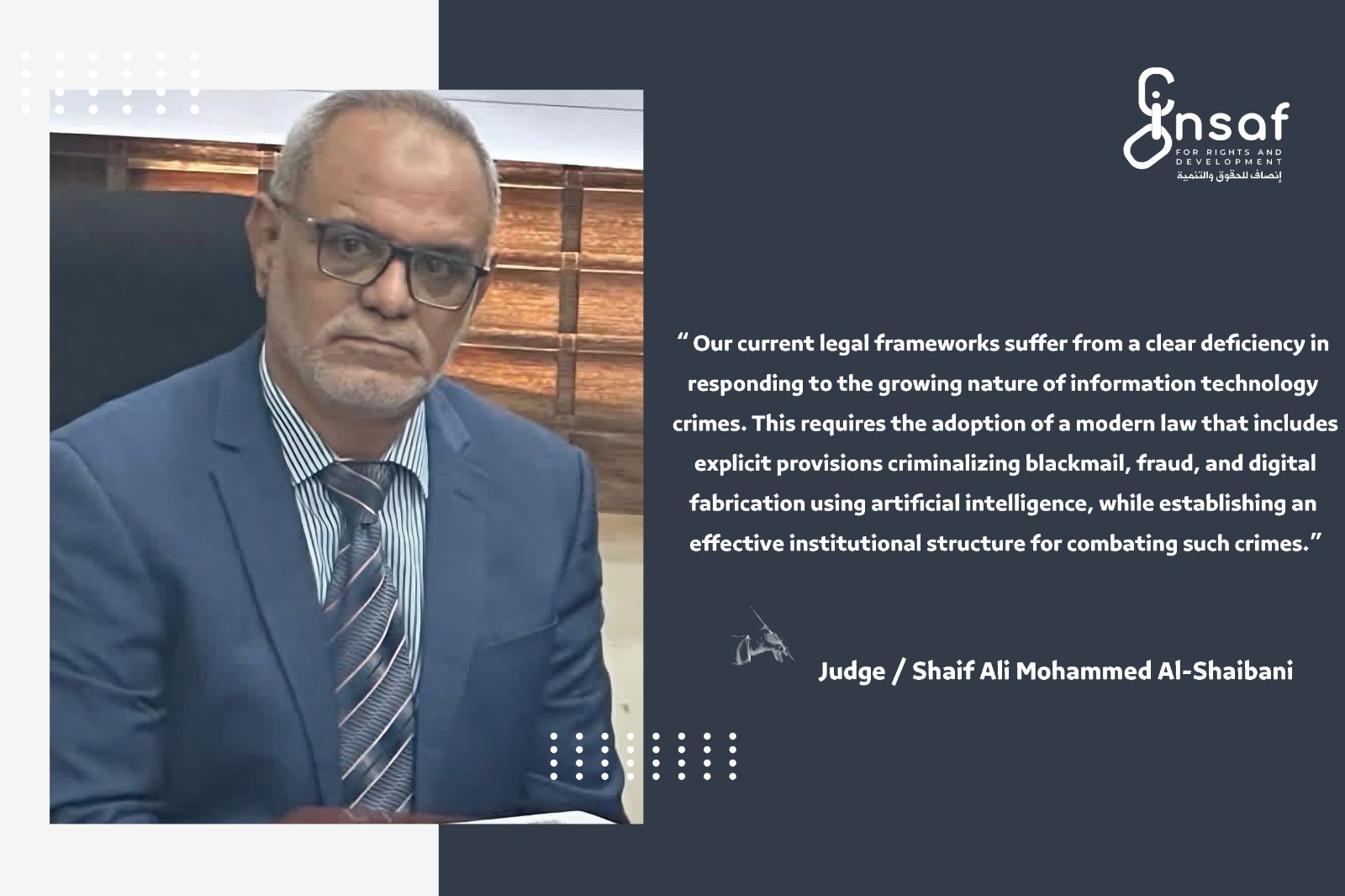
Seventh: Our current legal framework clearly suffers from shortcomings in responding to the growing threat of cybercrimes. Therefore, there is a pressing need to adopt a modern law with explicit provisions criminalizing online blackmail, fraud, and AI-based digital fabrication, while also establishing an effective institutional framework for combating such crimes.
Eighth: I call on victims to break the barrier of silence, because silence gives offenders more room to continue their crimes. Responding to blackmailers’ demands does not end the crime; rather, it opens the door to further exploitation. We stress that reporting channels must be safe and confidential in order to preserve the dignity of victims and protect them from stigma or prosecution.
Ninth: I call on society to treat online blackmail as a crime for which only the offender is responsible, and to provide victims with psychological, social, and legal protection, free from blame, public shaming, or victimization.
The slogan “Towards an Effective National Legislation,” launched by Insaf Center for Rights and Development, should represent a commitment by the Center to work with all partners until we see a realistic and well-crafted law that protects every household in Yemen.
Finally, I would like to renew my thanks to the French Embassy, Insaf Center, and the judicial leadership at the Office of the Attorney General. I also extend my appreciation to the Ministry of Justice and Legal Affairs for the participation of several of their staff members in this workshop, which reflects their belief that digital justice requires non-traditional skills and tools.
Judge / Shaif Ali Mohammed Al-Shaibani
Yemeni Judges and Legal Experts Draw a Roadmap to Combat Cybercrimes, Especially Online Blackmail