
Subtitles
Where Childhood Bleeds in Silence No One Hears
A Child Escaping War… Only to Fall Into a Crueler Trap
………….
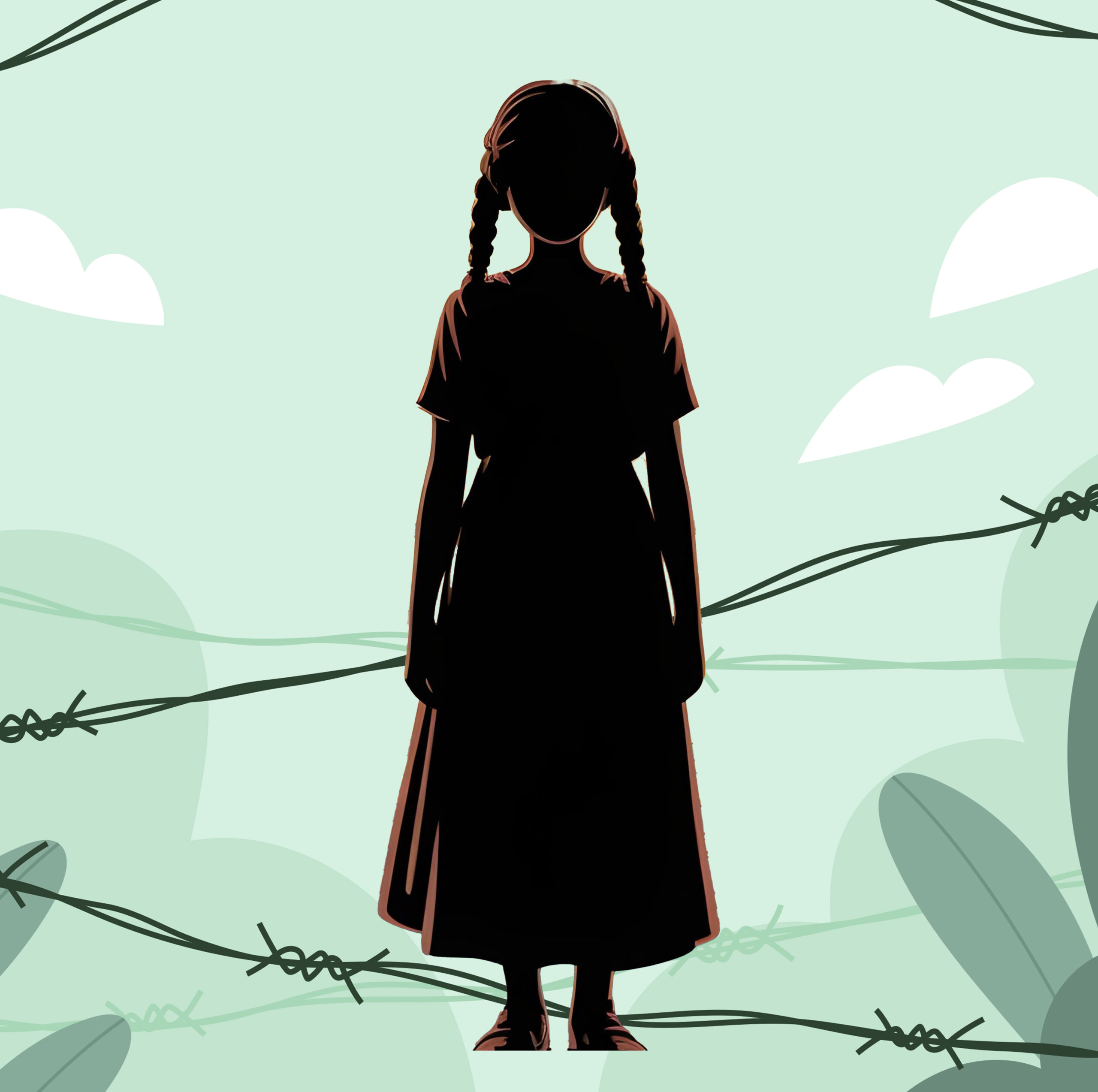
On a morning in 2019, Amani (a pseudonym), a girl not yet fourteen, went out as usual to collect plastic water bottles from the alleys of the village where her family had taken refuge — displaced from Taiz province to a rural area in one of Lahj’s districts in southern Yemen.
Amani fled the roar of the cannons only to find herself in a harsher margin of life — from a war that kills in masses to a reality that crushes with humiliation and need.
A Space Without Protection
Amani was the daughter of a marginalized family living in a small wooden shack — a shelter without a roof to shield them from the rain, and in a land without laws to protect them from passersby.
Her father, unemployed, sent her and her five siblings into the streets in search of food scraps from garbage bins or bits of plastic they could sell.
That morning, Amani left as usual… but she never came back the same.
On a deserted road, she was stopped by a man in military uniform belonging to one of the newly formed official brigades (established by presidential decree and under the coalition’s supervision). He pulled her away by force, in full view of a lone woman nearby — (N.S., 21 years old) — who tried to intervene but could not rescue Amani from the attacker, (A.H.).
He took the child in his vehicle to an abandoned place where only a small wooden shack stood. As Amani later recounted, it was there that her childhood was stolen from her forever.
A small body… and a threat bigger than her age
After the sexual assault on Amani, the attacker threw her near her house, drowning in her bleeding and fear, under the threat that if she filed a complaint against him, he would kill all her family members.
Amani was crawling toward the wooden hut; whenever she stood up, she fell, and whenever she cried, the bitterness choked her…
And when she reached the door of her house, she threw herself into her mother’s arms, crying… not understanding whether she was still alive or if life had just ended for her.
The mother, in turn, knew the attacker’s name but was powerless, as he was a soldier and they were displaced people — even thinking of filing a report meant risking all their lives.
The mother says: “Amani used to tell me that he was following her, but I was afraid… we have no support, no one hears us.”
Silence… another crime
In Yemen, hundreds of violations are committed against women and children without the victims’ voices reaching justice.
Silence here is not weakness but a means of survival, for fear of revenge, of society’s view, and of the absence of justice makes the victim a prisoner of her pain — living and dying in the shadows.
Amani found no doctor, no lawyer, no safe shelter…
But she found her aunt, who embraced her in another village, and there began her journey of psychological treatment, session after session, through the INSAF Center, which provided awareness services and psychological sessions for some cases in Al-Buraiqah District, Aden Governorate.
By coincidence, Amani was with her aunt in the Koud Qaro area of Al-Buraiqah District and received psychological support through the INSAF Center.
And Amani tried to convince her small heart that life does not end at the first betrayal.
The Lost Childhood in a Forgotten Country
Yemen — the country once called “Happy Yemen” — has become one of the most miserable places in the world for children.
Reports by the United Nations Children’s Fund (UNICEF) indicate that more than 11 million children in Yemen are in urgent need of humanitarian assistance, and that one in every ten children faces the risk of violence or exploitation.
UN data and international surveys also show that violence against children in conflict areas has reached record levels in recent years. In Yemen, specialized UN reports reveal that the grave violations children are subjected to — including killing, recruitment, and sexual assaults — continue to rise, and that the number of documented serious violations against children has reached alarming figures in recent annual reports. In the 2024 report of the Secretary-General on Children and Armed Conflict, monitoring and verification recorded tens of thousands of grave violations against children worldwide, with a notable increase in unverified cases of sexual violence.
More Dangerous Local Dimensions
Field documentation from national organizations has revealed even more alarming local dimensions. The investigative report by the INSAF Center for Rights and Development on marginalized children recorded 16 cases of sexual assault and harassment within its sample (including 8 females aged between 7 and 15 years and 8 males aged between 5 and 10 years). The report also described the poverty, displacement, and lack of protection faced by these groups. The INSAF Center points out that the real number is likely higher than recorded, as victims often refrain from reporting due to fear of shame and retaliation.
The INSAF report details the types of violations recorded: rape, sexual harassment, kidnapping/threats, and deprivation of protection services.
INSAF links the spread of these violations to weak local protection systems and the possibility of perpetrators escaping punishment — especially when they belong to armed formations or enjoy social influence.
Despite these numbers, most perpetrators remain unpunished, because justice here is as broken as the victims’ hearts.
JUSTICE4YEMEN Charter
“Shedding Light on Unreported Sexual Violence Against Children in Yemen’s War – Documented Cases,” June 2024.
It includes documentation from local organizations such as WATCH4HR, which recorded 13 cases between April 2022 and December 2023, along with analyses highlighting underreporting and the absence of official statistics.
The investigative report (SAFE II) documented 16 cases of rape/sexual harassment among marginalized children (details and age groups included).
A Law Without Enforcement… and Blind Justice
The Yemeni Penal Code (Law No. 12 of 1994) criminalizes sexual assault and rape, with provisions specifying varying penalties according to the severity of the crime and the circumstances (for example, the relevant article addresses rape and sets an aggravated penalty range if the assault causes serious harm or if the perpetrator is one of those responsible for the victim’s care).
The text of the law is available in official legislative references. The relevant articles (for reference, see the Penal Code No. 12 of 1994 — an electronically published version includes articles such as Article 269 and those following it).
(Verification from the official version):
“Article (269) of the Penal Code No. 12 of 1994 states:
(A text that criminalizes rape and specifies penalties, with aggravated punishment if the perpetrator commits the crime against a minor or has authority over the victim). Sexual assault on minors is punishable by imprisonment, which may reach the death penalty in aggravated cases.”
Yemen ratified the Convention on the Rights of the Child (CRC) in 1991, and under Article 34 of the Convention, States Parties are obligated to take “all appropriate measures” to protect children from sexual exploitation and sexual abuse, and to provide means for recovery and reintegration… which means that any local legislation or practice must comply with the state’s international obligations to protect the child and ensure access to medical and psychological care and criminal justice.
However, UN and local organization reports repeatedly state that Yemen lacks effective national mechanisms for receiving and following up on complaints, leading to a gap between international and local texts and the reality of protection on the ground.
But reality says: laws here are written in ink, erased by fear, and hung on office walls while childhood is raped in the alleys.
What is the use of a law that does not bring justice to victims?
Even when victims gather the courage to file a complaint, they face material and procedural barriers — the costs of litigation, travel, and legal fees may exceed the means of marginalized families, in addition to the lack of guarantees to protect witnesses and victims from retaliation.
Local and UN human rights reports indicate that the absence of effective protection mechanisms and the weakness of judicial authorities’ ability to investigate crimes committed by individuals linked to influential parties or armed groups increase the culture of impunity and make justice far removed from marginalized victims.
So what is the value of a law if it cannot reach those who have no voice?
Wounds That Do Not Heal
Amani received limited psychological sessions after moving to her aunt’s house in the Koud Qaro area of Al-Buraiqah District, Aden Governorate, through the INSAF Center, but the unfortunate reality is that psychological support and protection services for children who have survived violence are not widely available in Yemen, especially in rural areas and displacement camps…
Reports from local and international coalitions recommend an immediate increase in funding for psychological and social protection programs because their presence is limited and does not cover thousands of cases in need. And despite the psychological sessions that Amani received after moving to her aunt’s house, she and others like her are still haunted by the memories of sexual assault. Every time they hear a child’s laughter, they remember what was taken from them, because such support is unavailable to many children in Yemen due to weak protection funding; therefore, the memories still remain.
Perhaps Amani today lives in a state of semi-psychological stability, but her soul still walks barefoot on the ashes of fear.
Who Consoles Yemen’s Childhood?
Amani’s story is not an exception but a mirror of the reality suffered by thousands of children in Yemen.
Children deprived of school, of play, of care, of security… and even of their right to safe silence.
They do not need pity but justice… they do not want charity but dignity.
And in a country that has been burning for a decade, childhood remains the first to be thrown into the fire and the last to be rescued from it.
As if the homeland itself had conspired with the war to tell them:
“To be born a child in Yemen… is crime enough to be condemned to pain for life.”
A Cry in the Shadows
Amani is one of thousands of children who carry pain greater than their ages…
And the story should not end with pain only, but with a clear practical call to activate accountability and monitoring mechanisms, establish blacklists and accountability for individuals belonging to military formations involved, open safe and anonymous reporting channels for survivors, and then establish specialized police units to investigate crimes of sexual violence against children, and increase funding for psychological protection programs for children and displaced persons, and programs to rehabilitate members of armed formations as part of a comprehensive strategy to end impunity. These steps do not require an apology but a political and humanitarian decision to restore the stolen dignity of childhood in Yemen.
For our part, INSAF Center for Rights and Development works continuously to implement awareness sessions and community campaigns that encourage reporting violations and receiving support, assistance, and protection. The center also provides continuous psychological and social support to other girls like Amani, believing that protecting childhood is not just a slogan but a humanitarian commitment and a social responsibility.
And in order to enhance accessibility and transparency, the center has activated a mechanism for reporting any violation of children’s rights through a dedicated hotline that allows the reception of reports.
Main Sources (Reference List)
- INSAF Report for Rights and Development
- Justice for Yemen Agreement — “Documented Cases Highlighting Unreported Sexual Violence Against Children in the Yemen War” (June 2024)
- Report of the Secretary-General on Children and Armed Conflict (Annual CAAC Report 2024/2025) — Global and regional figures on grave violations against children and the verified increase in cases of sexual violence.
- Text of the Yemeni Penal Code No. 12 of 1994 — For reference to articles related to rape and sexual assaults (published copies available online).
- Other Governmental and International Reports on the Human Rights Situation in Yemen (Reports by the U.S. Department of State, Human Rights Watch, and local organizations) to support the paragraph on weak rule of law and lack of accountability.